

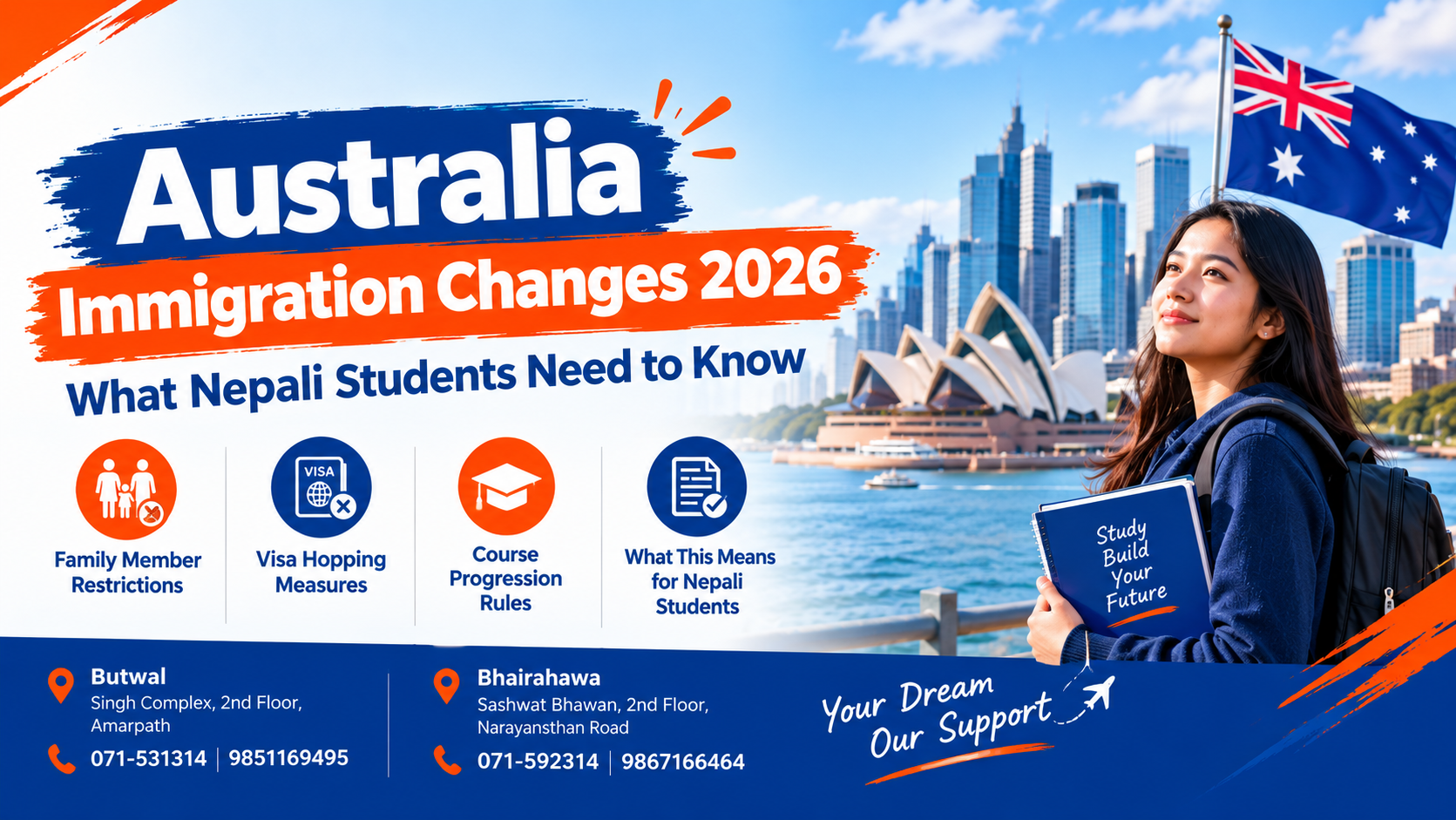
Australia has announced significant changes to its migration and student visa system in September 2026. The changes include new restrictions on family members accompanying international students, measures targeting “visa hopping,” and new requirements around course transfers and progression.
For students from Nepal planning to study in Australia, understanding these changes before choosing a course or preparing a visa application is important.
This guide explains the key announced changes and what they may mean for Nepali students.
On 17 September 2026, Australia’s Home Affairs Minister Tony Burke announced a series of migration reforms.
The student-related changes include:
Australia has announced that family members will generally no longer be automatically attached to new international student and graduate visa applications.
There are announced exceptions, including:
The Australian Government has also stated that families already in Australia with family members attached to an existing visa will not be separated because of this change.
For Nepali students, this means family plans should be considered carefully before applying.
For Nepali students planning a new application, the announced family restriction is particularly important.
Nepal is not identified in the announcement as part of the Pacific or ASEAN exemption. Therefore, Nepali applicants should not assume that they will be able to bring a spouse or child under the new arrangements.
However, the implementation of these measures is being introduced progressively, so students should check the latest Department of Home Affairs requirements at the time of application.
If you are considering Australia with your spouse or children, it is important to understand the rules that apply to your specific visa and course before making financial or travel commitments.
Another major focus of the 2026 reforms is what the Australian Government calls “visa hopping.”
The government has distinguished between legitimate visa progression and repeated visa changes primarily used to extend a person’s stay.
For example, a student may legitimately:
Bachelor’s Degree → Graduate Visa → Skilled Employment → Employer-Sponsored Visa
The government has said that this type of genuine progression is not the visa-hopping problem being targeted.
The concern is instead with repeated course or visa changes that do not represent genuine academic progression.
The announced reforms distinguish between different situations.
If you start a course and later discover that it is not suitable for your academic goals, transferring to another course may still be possible.
However, the government has announced that such a transfer may require a new student visa application so that the legitimacy of the change can be assessed.
There can also be legitimate reasons for needing additional time to complete your studies.
For example, circumstances affecting your ability to complete your existing course may require an extension.
Moving to a higher-level qualification remains part of legitimate academic progression.
For example:
Bachelor’s Degree → Master’s Degree
The government specifically used progression to a master’s degree after a bachelor’s degree as an example of legitimate progression.
Choosing your first course carefully is becoming even more important.
Students should consider:
A course should be selected because it makes sense for your education and career plans—not simply as a way to remain in Australia.
The announced reforms make an important distinction between existing visa holders and new applications.
The government has stated that it will not break up families already in Australia where family members are attached to an existing visa.
New applicants may be affected by the announced restrictions once the relevant measures come into effect.
Students planning to transfer or progress to another course may need to meet new visa requirements once the relevant changes are implemented.
Because the reforms are being introduced progressively, students should check the latest official requirements before submitting an application.
PhD and doctoral students were specifically mentioned by the Australian Government as an exception to the new family-member restriction.
However, students should not automatically assume that every postgraduate or research program qualifies.
A master’s degree, postgraduate coursework program, or other qualification should not be treated as equivalent to a PhD exemption without checking the applicable rules.
If you are planning to study in Australia, consider these important steps:
Select a course that matches your previous education and genuine career objectives.
If you are planning to travel with your spouse or children, check the current dependant requirements before applying.
Think about your realistic academic pathway before choosing your first course.
Make sure your academic, financial and other supporting documents are accurate and complete.
Immigration policies can change. Always verify the requirements applicable when you are actually preparing your application.
If you need to change your course, make sure there is a genuine academic or personal reason for the change and understand whether a new visa application is required.
Discuss your academic plans and visa documentation with experienced professionals before making major decisions.
The September 2026 announcement does not itself change permanent residency eligibility criteria.
However, students should remember that:
A student visa does not guarantee permanent residency.
PR eligibility can depend on separate immigration requirements, including the applicable visa pathway, occupation requirements, points criteria and other government policies.
Students should therefore choose their course based on genuine academic and career goals rather than treating a particular course as a guaranteed PR pathway.
The impact of these changes will depend on each student’s circumstances.
Before choosing Australia, students should consider:
Australia’s immigration policies are continuing to evolve, so students should rely on current official information rather than older visa advice or social-media rumours.
Australia has announced restrictions on adding family members to most new international student and graduate visa applications, with announced exceptions including PhD/doctoral students and nationals of Pacific and ASEAN countries. The implementation details and commencement of individual measures should be checked through official Australian Government sources.
Nepal has not been identified in the announced Pacific or ASEAN exemption. Nepali students should therefore check the applicable rules for their particular visa and course before planning to bring a spouse or child.
Visa hopping refers to repeated movement between visas or courses primarily to extend a person’s stay rather than for genuine study or other legitimate purposes. The Australian Government has announced measures intended to address this issue.
Legitimate course transfers can still be possible. Under the announced reforms, a course transfer may require a new visa application so the circumstances of the transfer can be assessed.
Yes. The Australian Government specifically identified progression from a bachelor’s degree to a master’s degree as an example of legitimate academic progression.
PhD and doctoral students were specifically identified as an exception to the announced family-member restriction. Students should confirm the current requirements applicable to their particular visa before applying.
No. A student visa does not guarantee permanent residency. PR pathways have separate requirements that can change over time.
Australia’s immigration system is changing, but the right approach is to understand the current requirements and plan your studies carefully.
At Pathway Butwal Abroad Study, we can assist students with course selection, university/college applications, documentation guidance and study-abroad counselling.
Start your Australia study journey with informed planning and the right guidance.
Your Pathway to Global Education. 🌎
Feel It, We Are Different.
📍 PATHWAY BUTWAL
Singh Complex, 2nd Floor, Amarpath, Butwal
📞 071-531314 | 9851169495
📍 PATHWAY BHAIRAHAWA
Sashwat Bhawan, 2nd Floor, Narayansthan Road, Bhairahawa
📞 071-592314 | 9867166464
Important: Australian immigration rules and implementation dates can change. Always verify the latest requirements through the Australian Department of Home Affairs before submitting an application.